


The eastern bluebird is one of the most recognizable backyard birds in North America. The male’s vivid sky-blue back, rust-orange chest, and white belly make him impossible to miss — even from across the yard. He’s a medium-small songbird, about the size of a large sparrow, with an upright perch posture that makes him look deliberate and alert.
Bluebirds are feeder-friendly in a specific way: they’re not traditional seed eaters, so a standard seed feeder won’t bring them in. What attracts them is open lawn for hunting insects, a reliable water source, and — most importantly — a properly placed nest box. Once you have those things set up, bluebirds can become surprisingly regular visitors, sometimes nesting two or three times in the same yard each season.
Once bluebirds discover your yard, they tend to return. They’re not flighty or hard to hold — if the habitat suits them, they’ll stay. If you’re building your first station, How to Attract Backyard Birds is a good place to start.
Jump to What You Need
- Quick Facts
- How to Identify an Eastern Bluebird
- Habitat & Range
- Best Feeders for Eastern Bluebirds
- Best Food
- Backyard Setup & Placement
- Seasonal Behavior
- Nesting
- Fun Facts
- Common Mistakes
- FAQ
Quick Facts
| Scientific Name | Sialia sialis |
| Size | 6.3–8.3 inches long |
| Wingspan | 9.8–12.6 inches |
| Lifespan | Up to 6–10 years |
| Feeder Friendliness | Medium (mealworms; not a seed feeder bird) |
| Range | Eastern U.S. and Canada, year-round in most of range |
| Best Feeder | Mealworm dish or bluebird feeder |
| Best Food | Live or dried mealworms, fruit |
How to Identify an Eastern Bluebird
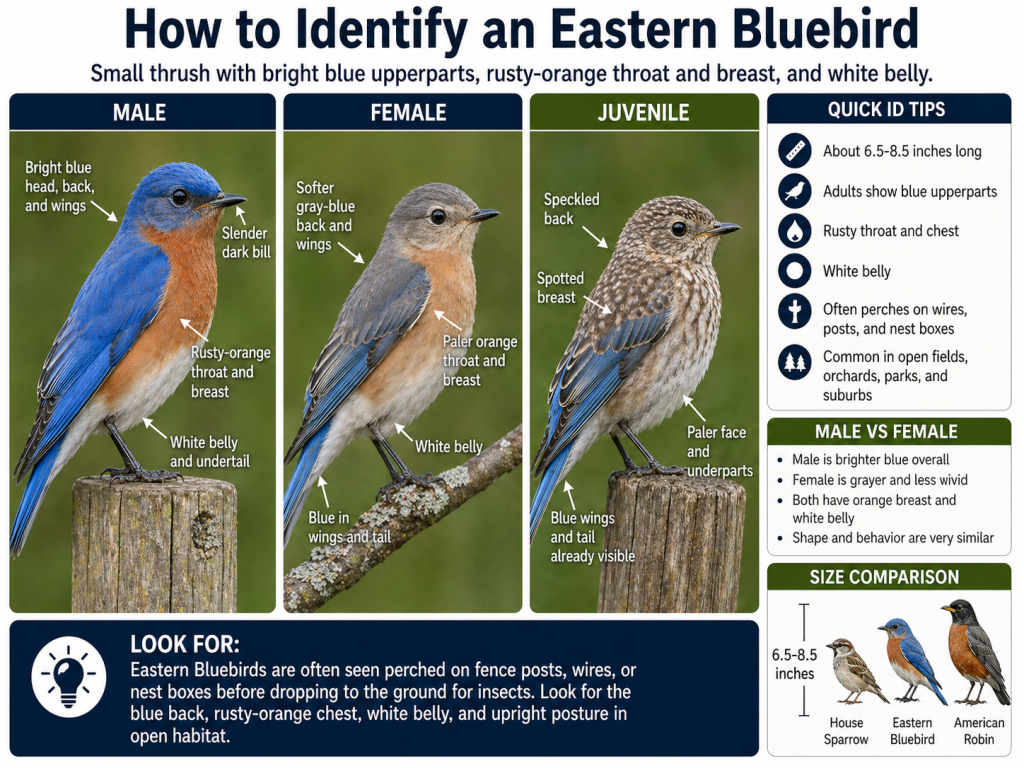
The male eastern bluebird is one of the most striking birds in any backyard. His back, wings, and head are a deep, brilliant blue — not the muted gray-blue of a jay, but a true sky blue that practically glows in sunlight. His chest and flanks are a warm rust-orange that fades to white on the belly. There’s no crested head, no bold streaking — just clean, vivid color.
The female is noticeably more muted. She has the same shape and body pattern, but her blue is restricted to the wings and tail, and her chest is a soft brownish-orange rather than the male’s rich rust. Juveniles are spotted and grayish, with just hints of blue in the wings — they look quite different at first glance.
The single best ID trick: Look for that upright posture on a fence post or low branch, with a brilliant blue back and a warm orange-red chest. No other small bird in the eastern U.S. has that combination. The similar-looking indigo bunting is smaller and entirely blue with no orange.
Calls and movement: Bluebirds have a soft, melodic, warbling call — a gentle chur-lee or tu-a-wee that carries well. They hunt from low perches, dropping to the ground to snatch insects, then returning to the same post. That repeated drop-and-return movement is a reliable behavioral giveaway even before you get a good look at color.
Habitat & Range
Eastern bluebirds are found across the entire eastern half of the United States, from southern Canada to the Gulf Coast. Most of the population is year-round, though northern birds may move south during harsh winters. In much of the Midwest and Southeast, bluebirds are present 12 months a year.
They favor open habitats — meadows, orchards, golf courses, rural roadsides, and suburban yards with large lawns. They need two things: a place to hunt insects from a low perch, and a cavity to nest in. Mature trees with natural holes used to fill that second need; now, nest boxes do the job in most backyard settings.
If your yard has a combination of open grass and some wooded edge nearby, you’re in prime bluebird territory. Dense tree coverage, thick shrubs, and manicured landscaping with no ground-level open space tend to push them away.
Best Feeders for Eastern Bluebirds
Eastern bluebirds are one of the most popular backyard birds in the country — but they don’t respond to the feeders most people already have. If you’re comparing options across feeder types, Best Bird Feeders breaks down what works for different birds — but for an eastern bluebird, the setup is less about feeder style and more about food choice and placement.
Mealworm Dish or Bluebird Feeder ⭐ Best Choice
Bluebirds are insect hunters — their natural diet is made up primarily of invertebrates and berries, not seeds. A shallow dish feeder stocked with mealworms matches that preference directly. Once bluebirds discover the food source, they’ll return to the same dish again and again, sometimes bringing their young along after fledging.
A dedicated bluebird feeder (an enclosed box with entry holes sized for bluebirds) adds a layer of protection from competing birds like starlings. These are more effective in yards with heavy competition for food, and they help bluebirds feel secure while feeding.
The main downside is that mealworms — especially live ones — require some management. Dried mealworms are easier and still work well once bluebirds are already visiting regularly.
Platform Feeder — Good Secondary Option
A low, open platform feeder can also work for bluebirds, especially for offering fruit. Bluebirds will take berries and softened fruit from a flat surface, particularly during cold stretches when insects are scarce. It’s not their first preference, but a platform stocked with fruit or dried mealworms can supplement a mealworm dish effectively.
The tradeoff: open platforms attract more competing birds, and bluebirds can be pushed off by more aggressive species like starlings or mockingbirds.
👉 Platform Bird Feeders — Full Guide
Best Food for Eastern Bluebirds
Getting the food right makes a bigger difference than most people expect. Choosing the right food can dramatically increase how often eastern bluebirds visit your yard — more so than any feeder upgrade. Bluebirds eat insects and berries in the wild, and the best backyard foods mirror that closely.
Mealworms ⭐ Top Choice
Mealworms are the single most effective way to attract eastern bluebirds. Live mealworms get a faster response when you’re first trying to establish visits — the movement catches the birds’ attention. Dried mealworms work well once bluebirds are already familiar with your yard and know where to look.
Mealworms work in every season, but they’re especially valuable in winter and early spring when natural insect prey is hard to find. A small dish of mealworms in February or March can make your yard one of the first places bluebirds check when they’re scouting nesting territory.
Fruit and Berries
Bluebirds regularly eat wild berries — dogwood, holly, viburnum, and native sumac are favorites. In a backyard setting, you can offer softened raisins, small pieces of apple, or dried fruit on a platform feeder. Bluebirds will take these especially in fall and winter when insects are scarce.
Native berry-producing shrubs do double duty: they provide food and attract bluebirds to your yard even when you’re not actively maintaining a feeder.
Suet (Rarely)
Some bluebirds will occasionally visit suet feeders, especially in cold weather. It’s not their preferred food, but an insect-flavored suet blend may get some attention during winter. Don’t count on it as a primary draw — use it as a supplement if you already have a suet feeder in your yard.
What to Avoid
Standard birdseed — black oil sunflower, safflower, millet — will not attract eastern bluebirds. They are not seed eaters and will ignore a standard tube or hopper feeder. Mixed seed blends, nyjer/thistle, and corn are equally ineffective. Bread and kitchen scraps are also a hard pass — they provide no nutritional value and can attract pest species that compete with bluebirds.
Beginner shortcut: Start with a shallow mealworm dish and a pack of dried mealworms. That combination reliably attracts eastern bluebirds and creates the repeat visits that make backyard birding satisfying.
Backyard Setup & Placement
The most important element in a bluebird-friendly yard is the nest box. Mount it on a smooth metal pole (to deter predators) in an open area with at least 30–50 feet of open lawn nearby. A height of 4–6 feet is ideal — low enough to monitor, high enough to feel secure to the birds. Face the entrance hole east or north to avoid overheating.
Place your mealworm dish within sight of the nest box — bluebirds will naturally shuttle between nesting and feeding spots. Keep it on a separate, lower mount or pole, not attached directly to the nest box. Bluebirds are territorial and can stress if feeding and nesting competition is occurring at the same spot.
A birdbath nearby rounds out the setup. Bluebirds bathe and drink regularly, and moving water is especially attractive to them — a dripper or solar-powered fountain will draw them in faster than a still bath.
This setup works because bluebirds are hunters that need a clear field of vision to spot insects and movement. Dense plantings and cluttered feeders work against their natural behavior; open space and clear sight lines work with it.
👉 How to Attract Backyard Birds 👉 Simple Backyard Bird Setup
Seasonal Behavior
Winter: In most of their range, eastern bluebirds are year-round residents but they shift behavior significantly in cold months. They roost communally for warmth and move in small flocks rather than pairs. Feeder visits for mealworms and fruit increase during cold stretches when ground insects are unavailable. This is a great season to establish your mealworm station — hungry birds are receptive to new food sources.
Spring: One of the most active seasons for bluebirds in the backyard. Males arrive at nest boxes early and begin defending territory aggressively — you may see them hovering near the box entrance and chasing off competitors. Mealworm demand picks up sharply as nesting begins and parents need high-protein food. This is when a well-placed nest box with a nearby dish can anchor a pair to your yard for the whole season.
Summer: Bluebirds are actively nesting and raising young. Feeder activity can temporarily dip as adults forage widely, but they’ll return consistently when chicks are in the nest. Once the first brood fledges, you’ll often see the parents feeding the young from your mealworm dish — a memorable sight. Many pairs go on to a second or even third brood through July.
Fall: Young-of-year birds are now independent and family groups begin to consolidate. Bluebirds shift toward berries and fruit as insects become scarce. This is an excellent time to plant native berry shrubs if you want to hold bluebirds through winter. Feeder activity stabilizes as the breeding season ends and birds settle into cooler-weather routines.
Nesting
Eastern bluebirds are cavity nesters — they need a hole to nest in and do not build their own. They historically used abandoned woodpecker holes and natural tree cavities, but habitat loss eliminated most of these. Today, nest boxes are the primary nesting site for many backyard bluebird populations, and nest box programs have helped reverse decades of population decline.
A standard bluebird nest box with a 1.5-inch entrance hole, mounted on a smooth pole with a predator baffle, is the single most impactful thing you can add. Clean out the box between broods and at the end of each season to prevent parasites and encourage re-use the following spring.
Eggs per clutch: 3–7 (typically 4–5) Broods per year: 2–3 Incubation: 13–16 days Nestling period: 17–21 days before young leave the nest
Fun Facts
Eastern bluebirds nearly disappeared from much of their range by the mid-20th century, driven out by habitat loss and competition from introduced species. Nest box programs launched in the 1970s and 80s helped reverse that trend — today the species is thriving largely because of backyard birders.
Male bluebirds don’t just sing to attract a mate — they also bring nesting material to the box and display near the entrance to demonstrate it’s a suitable site. The female makes the final call on whether to accept it.
Bluebirds can spot an insect on the ground from over 60 feet away. Their vision is sharp enough to detect prey movement at distances that would look like bare lawn to a human observer.
A family of eastern bluebirds can consume hundreds of insects per day during the nesting season. A backyard pair with nestlings is a natural pest control system — caterpillars, beetles, grasshoppers, and crickets all end up in the nest.
Common Mistakes
Using the wrong food. The most common mistake bluebird beginners make is putting out a seed feeder and waiting. Bluebirds don’t eat seed. They will fly right past a well-stocked sunflower feeder without a second glance. The only food that reliably draws them in is mealworms — start there and don’t bother with seed.
Poor nest box placement. Mounting a bluebird box in a wooded or heavily shaded area is one of the fastest ways to ensure it goes unused. Bluebirds won’t nest where they can’t see the ground — they need open sightlines in every direction. A box at the edge of dense trees, surrounded by shrubs, or tucked into a corner of the yard will be ignored. Open lawn and clear flight paths are non-negotiable.
Assuming a missing bluebird means failure. Bluebirds can disappear from a yard mid-season and lead people to think something went wrong. Most of the time, it’s normal. After the first brood fledges, adults may range farther while the young disperse. A week or two gap between nesting rounds is common. Don’t pull the box — they usually return.
Removing native plants for a “cleaner” yard. Mowed grass and manicured landscaping can feel like a well-maintained yard, but removing native shrubs, berry-producing plants, and natural ground cover strips away the food and habitat that bluebirds need when mealworms aren’t available. A few native hollies, dogwoods, or viburnums can keep bluebirds in your yard through fall and winter when the feeder alone wouldn’t hold them.
Frequently Asked Questions
What is the best feeder for an eastern bluebird?
A shallow dish or dedicated mealworm feeder is the most effective option for eastern bluebirds. They don’t use tube or hopper feeders, so standard seed setups won’t bring them in. Position the dish in an open area with good visibility — bluebirds prefer to feed where they can see potential threats. If you also want to offer fruit or dried mealworms on an open surface, the Platform Bird Feeders — Full Guide can help with placement and setup.
What food attracts eastern bluebirds the most?
Mealworms — either live or dried — are the most reliable food for attracting eastern bluebirds. Live mealworms get the fastest initial response; dried mealworms work well once birds know where to look. Fruit and berries are a useful supplement, especially in fall and winter when insects are scarce. The Best Bird Seed guide covers the full breakdown of what works for which birds.
How do I identify an eastern bluebird?
The male eastern bluebird has a brilliant sky-blue back and wings with a warm rust-orange chest and white belly — a combination no other common backyard bird in the eastern U.S. matches. The female has the same body pattern but with more muted tones: softer blue limited to the wings and tail, and a pale brownish-orange chest. Look for the upright perch posture on low branches or fence posts as a behavioral giveaway before color is visible.
Do eastern bluebirds migrate?
Eastern bluebirds are mostly year-round residents throughout their range. Some northern populations move south during harsh winters, but most birds in the eastern and southeastern U.S. stay put year-round. In cold winters, they shift from insects to berries and move in small flocks rather than pairs — so they may look and behave differently than you’re used to seeing in spring and summer.
Why did my eastern bluebird stop coming to the feeder?
The most common reason is a natural break between nesting rounds. Bluebirds often range widely after the first brood fledges before returning to nest again. If it’s late summer or fall, they may have shifted to foraging for wild berries rather than visiting a mealworm dish. Check that the dish is clean, the mealworms are fresh, and the area around the feeder hasn’t changed in ways that might make bluebirds feel exposed.
Are eastern bluebirds good for beginners?
Absolutely — with one caveat. They require a different setup than most backyard birds: mealworms instead of seed, and ideally a nest box, rather than a standard tube feeder. Once you have that in place, they’re one of the most rewarding birds to attract. They’re reliably visible, easy to identify, and tend to return to the same yard season after season. The nest box element also gives beginners a tangible project that pays off quickly.
What other birds might I see alongside an eastern bluebird?
In open-yard habitats, bluebirds often share space with American robins, dark-eyed juncos, and mourning doves. Tree swallows are frequent nest box competitors — if you have a nest box trail, space boxes at least 300 feet apart or pair them as a bluebird-swallow combo 15–25 feet apart. House wrens and house sparrows may also compete for cavity space in some yards.
Related Pages
👉 Best Bird Feeders 👉 Platform Bird Feeders — Full Guide 👉 Best Bird Seed 👉 How to Attract Backyard Birds 👉 Backyard Birds by Species 👉 American Robin 👉 Dark-eyed Junco 👉 Mourning Dove 👉 New York State Bird — Eastern Bluebird 👉 Missouri State Bird — Eastern Bluebird