

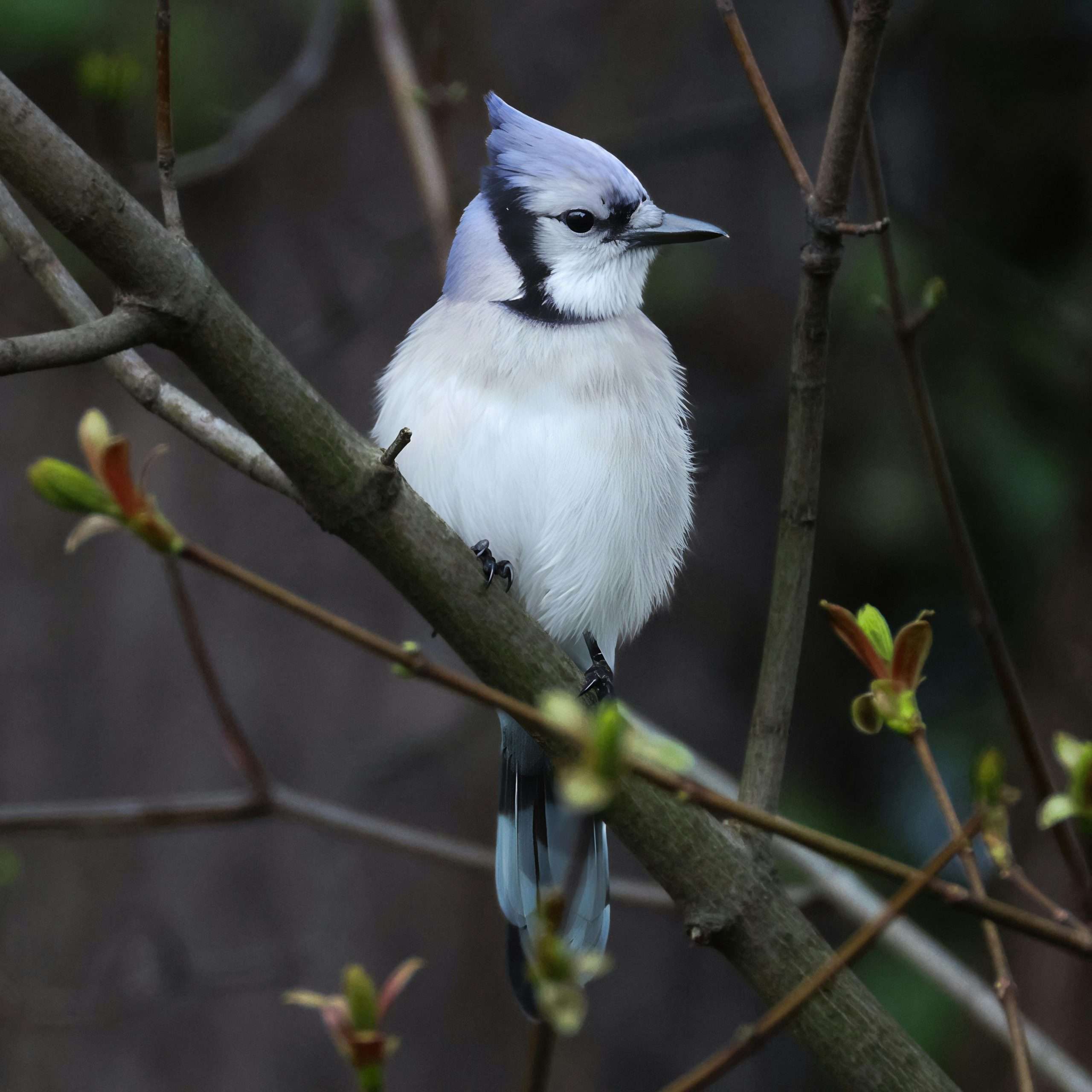
Blue jays are one of the most recognizable backyard birds in the eastern United States — and one of the most entertaining to watch. At 9–12 inches long with vivid blue plumage, a sharp black collar, and a raised crest, they announce themselves the moment they land. Loud, intelligent, and impossible to ignore once they become regular visitors, blue jays bring a level of personality to a feeder setup that quieter songbirds simply don’t.
They’re feeder-friendly and visit consistently once they find a reliable food source. At feeders, blue jays are larger than most songbirds, so they tend to land with confidence — taking their time, surveying the area, and often carrying off a seed or peanut before returning for another. You’ll notice they’re as interested in the territory around the feeder as the food itself.
Blue jays are year-round residents across most of their range, which means once you attract them, they tend to stick around. If you’re building your first station, How to Attract Backyard Birds is a good place to start.
Jump to What You Need
- Quick Facts
- How to Identify a Blue Jay
- Habitat & Range
- Best Feeders for Blue Jays
- Best Food
- Backyard Setup & Placement
- Seasonal Behavior
- Nesting
- Fun Facts
- Common Mistakes
- FAQ
Quick Facts {#quick-facts}
| Scientific Name | Cyanocitta cristata |
| Size | 9–12 inches long |
| Wingspan | 13–17 inches |
| Lifespan | Up to 7 years in the wild (17+ in captivity) |
| Feeder Friendliness | High |
| Range | Eastern and central United States, southern Canada |
| Best Feeder | Platform feeder |
| Best Food | Peanuts (in-shell or shelled), black oil sunflower seeds |
How to Identify a Blue Jay
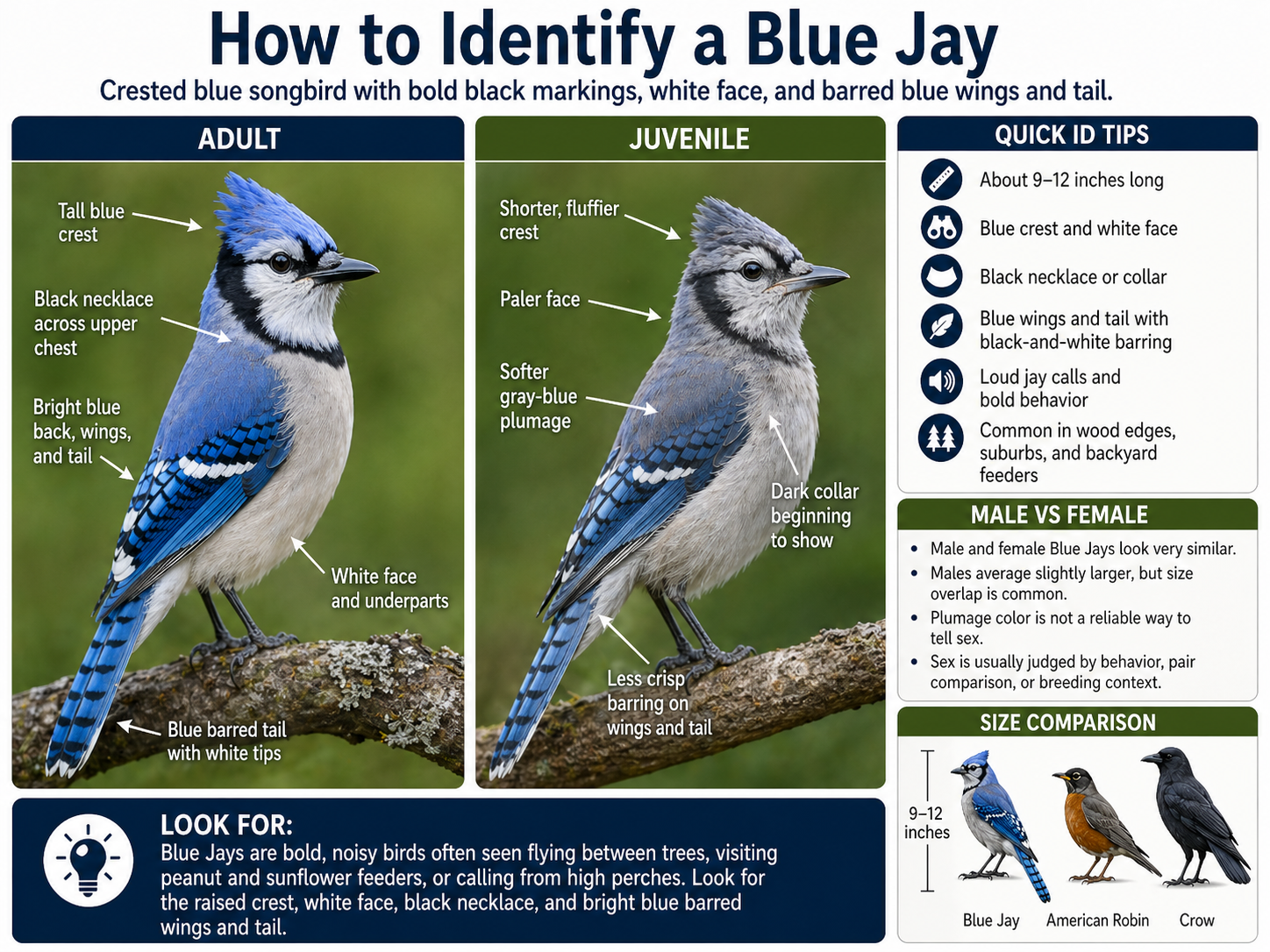
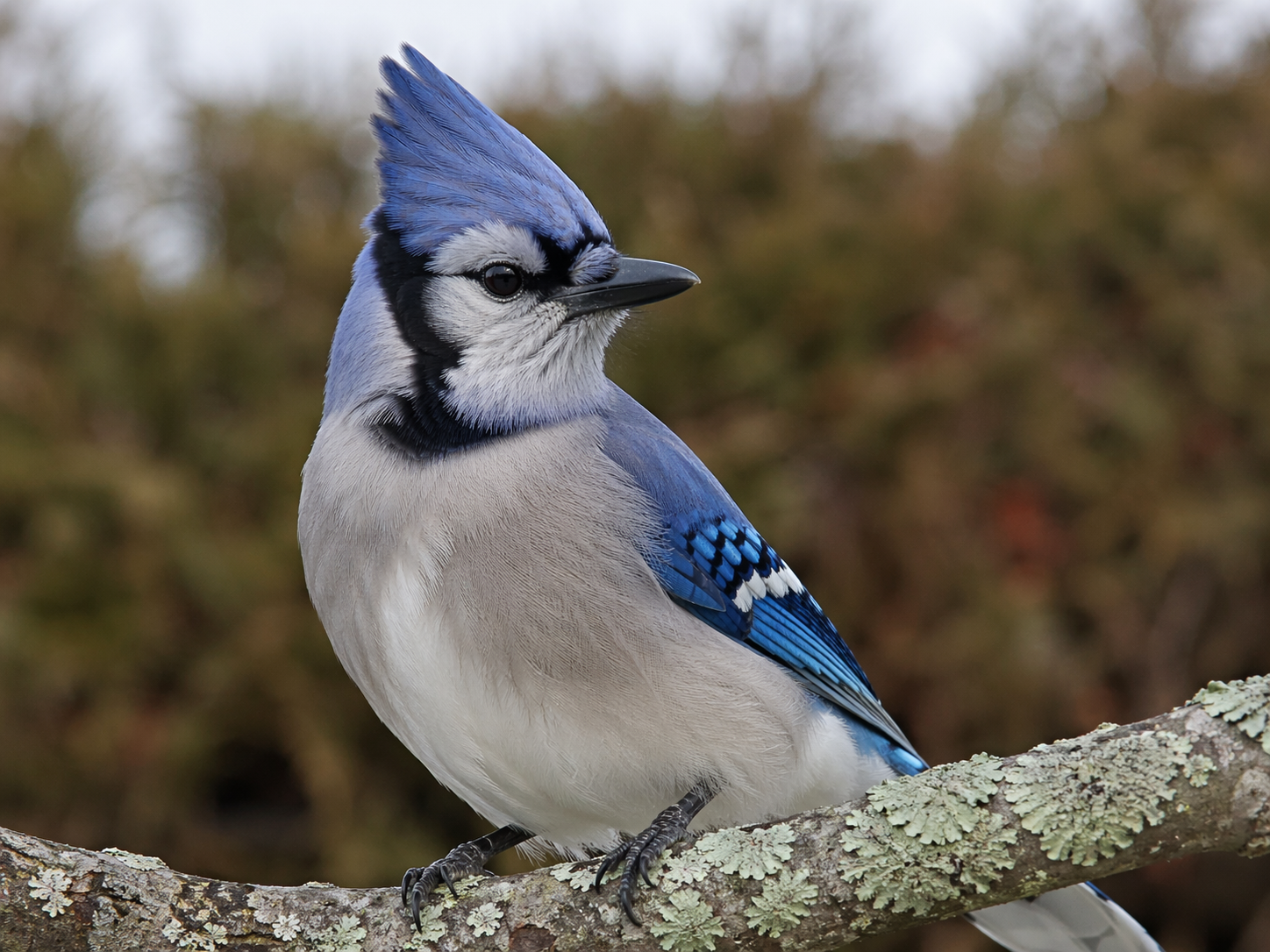
Blue jays have a bold, unmistakable look: vivid blue on the back, wings, and tail, with a white face and underside divided by a sharp black collar that wraps around the throat and neck. The wings show distinct black barring and white spots. In flight, the white corners of the tail are easy to spot.
Males and females look nearly identical — blue jays are one of the few species where you can’t reliably tell them apart by color. Juveniles are slightly duller and softer-looking than adults but follow the same basic pattern.
The single best ID trick: Look for the crest. Blue jays raise it when alert or excited and flatten it when relaxed or feeding. No other common backyard bird of similar size has that combination of blue coloring and a moveable head crest.
Calls and movement: Blue jays are loud and vocal — their “jay jay” call is sharp and carries far. They also mimic the calls of Red-tailed and Red-shouldered Hawks convincingly enough to fool other birds (and many people). At feeders, they tend to land deliberately, grab a large seed or peanut, and fly off to eat it elsewhere or cache it for later.
Habitat & Range
Blue jays are found throughout the eastern and central United States and into southern Canada. They’re year-round residents across most of their range, though some northern populations do move south in fall — often in noisy, visible flocks.
They thrive in suburban neighborhoods and adapt easily to residential yards, especially those with mature deciduous trees. Oak trees are particularly attractive to them — blue jays are one of the primary spreaders of acorns, and a yard with oaks will get more jay activity than one without. They’re also commonly found at woodland edges, parks, and open wooded neighborhoods.
Best Feeders for Blue Jays
Blue jays are one of the most feeder-friendly birds you can attract. If you’re comparing options across feeder types, Best Bird Feeders breaks down what works for different birds — but for a blue jay, the decision is usually straightforward.
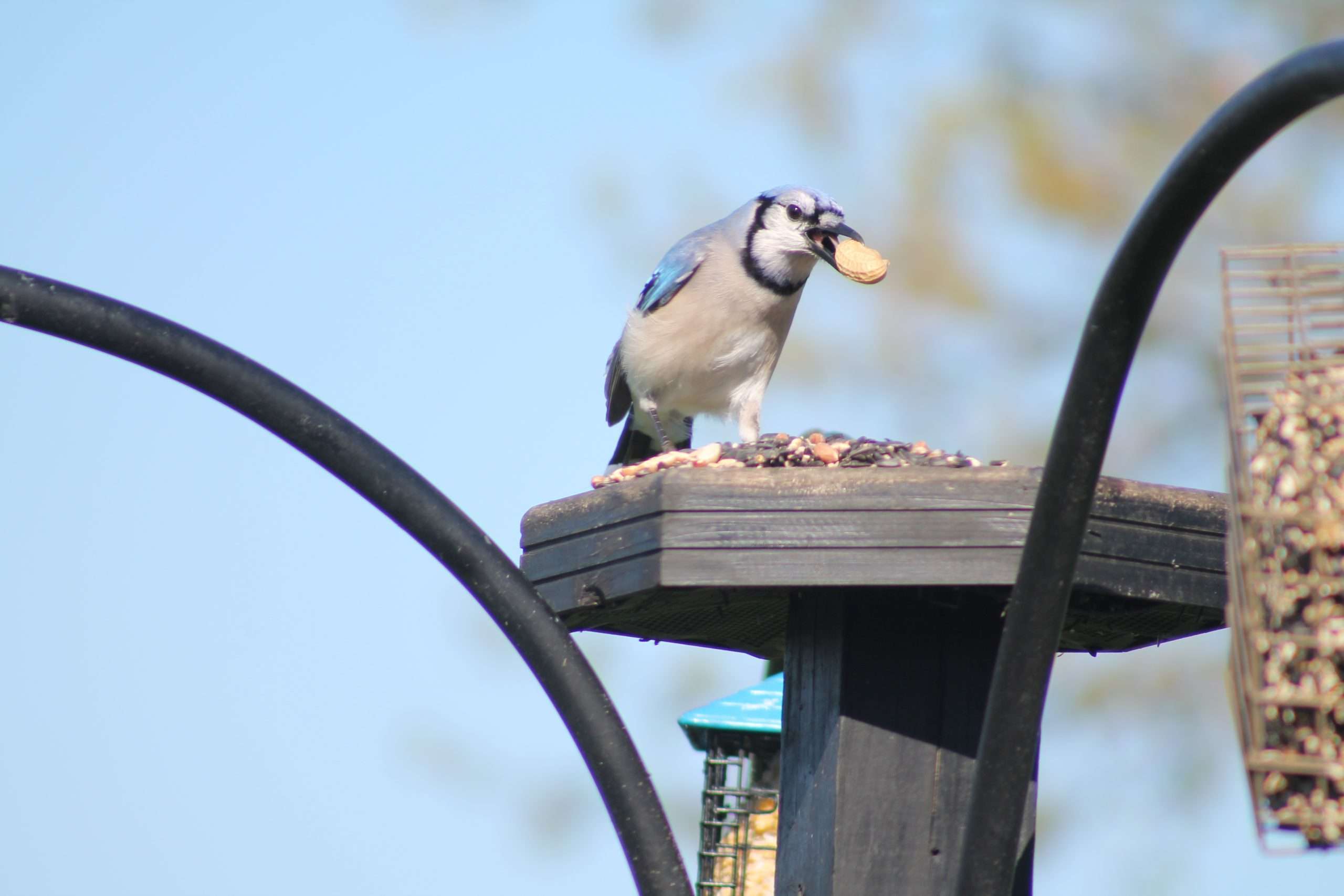
Blue jays are larger than most feeder birds and prefer a roomy, open surface where they can land comfortably and see what’s available. Platform feeders deliver exactly that — no hopper door to navigate, no perches too small for their feet, just an open tray they can land on and work.
The open design also makes it easy to offer peanuts in the shell, which blue jays will happily carry off one by one to cache. You’ll get more visible jay activity at a platform feeder than at any other type.
Platform feeders do accumulate debris and moisture, so rinse them out every week or so to keep seed fresh.
👉 Platform Bird Feeders — Full Guide
Hopper Feeder — Good Secondary Option
Hopper feeders work well for blue jays as long as they have a wide enough tray and sturdy perches. Blue jays can grip a standard hopper perch fine, and the covered design helps keep seed dry — which matters more in wet seasons.
The limitation is space. A narrow hopper tray can feel cramped for a bird this size, and blue jays may simply prefer the open surface of a platform. That said, if a hopper is already part of your setup and it holds sunflower seeds, jays will use it.
👉 Hopper Bird Feeders — Full Guide
Ground Feeding Area — Useful in a Mixed Station
Blue jays naturally forage on the ground and will readily feed below a platform feeder where seeds and peanuts have fallen. A designated ground feeding area — even just a shallow tray on the ground or a low platform — can reduce competition at elevated feeders and give ground-preferring jays their own space.
Keep ground feeding areas away from dense cover where cats or other predators could hide.
Best Food for Blue Jays
Getting the food right makes a bigger difference than most people expect. Choosing the right food can dramatically increase how often blue jays visit your yard — more so than any feeder upgrade. In the wild, blue jays eat acorns, nuts, seeds, insects, and occasionally eggs or nestlings. At feeders, they zero in on the largest, densest options available.
Peanuts ⭐ Top Choice
Blue jays are one of the strongest peanut birds you can attract. Their heavy bills are built for cracking shells, and they’ll take whole in-shell peanuts, carry them off, and cache them one by one. Once a blue jay discovers a peanut source, it will return consistently — often multiple times per day.
Unsalted peanuts in the shell are the top choice. Shelled peanut halves work well too and will attract a wider range of birds alongside jays. Just avoid salted or flavored peanuts, which aren’t good for birds.
Black Oil Sunflower Seeds
Sunflower seeds are the second-best option — widely available, accepted by blue jays without hesitation, and useful for attracting other species to the same feeder. Blue jays prefer the whole seed over chips, since they like something to work with.
Sunflower Chips
Shelled sunflower chips are convenient and reduce shell debris under feeders. Blue jays will eat them readily, though they seem to prefer whole seeds when both are available.
Suet
Suet isn’t a primary draw for blue jays, but they will occasionally visit a suet feeder, especially in winter when high-fat foods become more valuable. If you’re already running a suet feeder for woodpeckers, expect jays to check it from time to time.
What to Avoid
Cheap mixed seed blends loaded with milo, millet, or filler grains won’t attract blue jays and will mostly pile up uneaten. Corn can draw jays, but it comes with tradeoffs — especially increased squirrel activity.
Beginner shortcut: Start with a platform feeder and a bag of unsalted in-shell peanuts. That combination reliably attracts blue jays and creates the repeat visits that make backyard birding satisfying.
Corn is worth avoiding even though blue jays will eat it — it attracts squirrels heavily and can quickly take over your setup. The tradeoff isn’t worth it when peanuts do the job better with fewer problems.
Backyard Setup & Placement
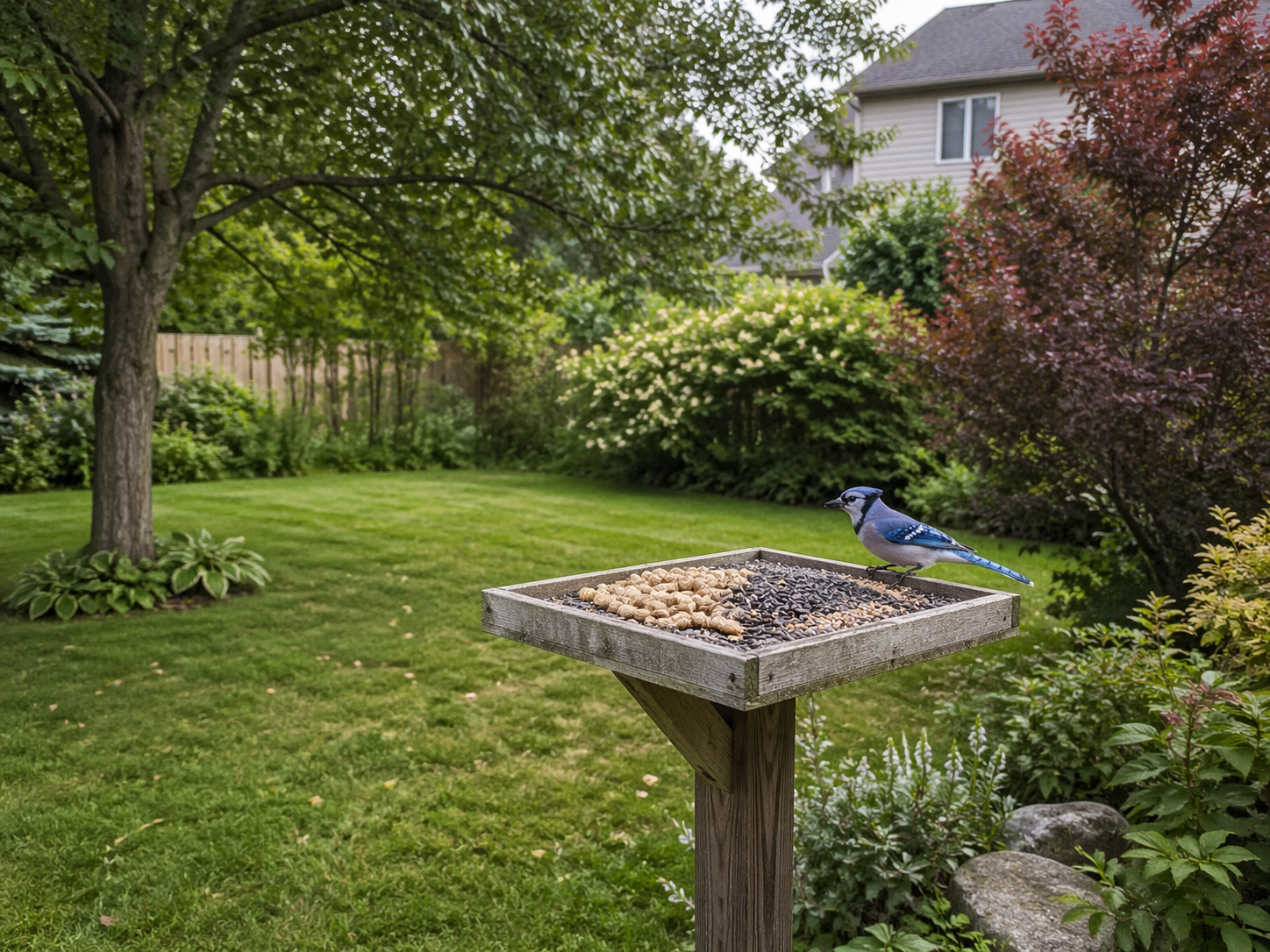
Place your platform feeder 5–10 feet from trees or dense shrubs. Blue jays want open sightlines while feeding — they’re alert birds that scan constantly for threats — but they also want to be able to get to cover quickly. That 5–10 foot range satisfies both.
Height matters less for blue jays than for some species, but 4–6 feet off the ground works well. Avoid clustering multiple feeders too tightly together; blue jays can be territorial and will sometimes monopolize a feeding area if everything is packed into one spot.
A birdbath nearby will increase overall yard activity and is worth adding once your feeder setup is established. Blue jays do bathe and drink regularly.
This setup works because blue jays are bold but cautious foragers — they prefer to land in the open where they can see approaching threats, then retreat quickly to tree cover if needed. A setup that offers open access with nearby escape routes matches how they naturally move.
👉 How to Attract Backyard Birds 👉 Simple Backyard Bird Setup
Seasonal Behavior
Winter: Blue jays are highly active at feeders in winter and one of the more reliable cold-weather visitors. They shift from a varied diet toward stored food and feeder visits, and you may start seeing small family groups rather than lone birds. Peanuts become especially valuable in cold weather — expect more jay traffic if peanuts are on offer.
Spring: Jay activity at feeders decreases somewhat as natural food becomes more available. Breeding season also makes them more territorial and vocal. You may notice more aggressive behavior around the feeder as pairs establish nesting areas and defend territory.
Summer: Feeder visits drop further as insects and natural seeds become plentiful. Young-of-the-year jays start appearing in late summer — they look similar to adults but may be less coordinated at the feeder and more hesitant around other birds.
Fall: Fall brings one of the most interesting blue jay behaviors: caching. Jays will make rapid, repeated trips to a peanut or sunflower feeder, taking one item at a time and flying off to bury it for winter storage. A single jay can cache thousands of items in a season. Feeder activity increases noticeably in fall as jays build their winter reserves.
Nesting
Blue jays build bulky, well-constructed nests in the forks of tree branches, typically 10–25 feet off the ground. They prefer mature deciduous trees but will use conifers or dense shrubs. Nests are made from twigs, bark strips, moss, and rootlets, often bound with mud for structure.
Blue jays don’t use nest boxes, so there’s no nest box setup that will attract them. The best thing you can do for nesting blue jays is maintain trees and shrubs in your yard — they need real structure to build in.
Eggs per clutch: 3–6 Broods per year: 1 (occasionally 2) Incubation: 16–18 days Nestling period: 17–21 days before young leave the nest
Fun Facts
Blue jays are corvids — members of the same family as crows and ravens — which explains their problem-solving ability and strong memory. They’re significantly smarter than most feeder birds.
They mimic the calls of Red-tailed and Red-shouldered Hawks with surprising accuracy. This may serve as a warning system, a way to scare other birds off a food source, or possibly both.
The blue in a blue jay’s feathers isn’t actually blue pigment — it’s structural color produced by the way the feather cells scatter light. Crush the feather and the color disappears.
Blue jays are one of the most important seed dispersers for oak trees in North America. A single jay can cache 4,500+ acorns in a single fall season, many of which germinate into new trees when they’re not retrieved.
Common Mistakes
Wrong food. The most common mistake is loading a feeder with cheap mixed seed and wondering why jays aren’t interested. Blue jays ignore milo, millet, and filler-heavy blends. They want peanuts and sunflower seeds. If you’re not offering either, you’re not really set up for jays.
Feeder too small. Blue jays need room to land and maneuver. A small tube feeder or narrow perch style will frustrate them. If they visit once and can’t get comfortable, they’ll stop coming. Use a platform or a hopper with a wide tray.
Placed too close to the house or too far from cover. Blue jays are alert and won’t linger at a feeder where they feel exposed or trapped. Right up against a window or wall can feel too confined. Out in the open with no nearby trees makes them nervous. The 5–10 foot rule from cover is worth following.
Expecting them to share well. Blue jays will chase smaller birds from feeders — that’s just their behavior. If you want to keep feeding smaller songbirds and blue jays, use separate feeder stations set some distance apart. A dedicated peanut spot for jays can reduce competition at your main seed feeder.
Frequently Asked Questions
What is the best feeder for a blue jay?
A platform feeder is the top choice — the open surface gives blue jays room to land comfortably and maneuver without crowding. Hopper feeders with wide trays work well too, especially for sunflower seeds. Avoid small tube feeders, which are too cramped for a bird this size. See the full Platform Bird Feeders — Full Guide for specifics on styles and placement.
What food attracts blue jays the most?
Peanuts are the top draw — unsalted, in the shell if possible, though shelled halves work fine too. Black oil sunflower seeds are a strong second. If you put out both, expect regular jay visits once they’ve located the source. The Best Bird Seed guide covers the full breakdown of what works for which birds.
How do I identify a blue jay?
Look for the crest — that raised tuft of feathers on the head that no other common backyard bird of similar size has. Combined with the vivid blue back, black collar, and white underside, there’s nothing else it can really be confused with. The closest look-alike is the Steller’s Jay of the western U.S., which is darker and lacks the white underparts.
Do blue jays migrate?
It’s complicated. Some blue jays migrate and others don’t — even within the same population. Most birds in the eastern U.S. are year-round residents, but northern populations often move south in fall, sometimes in large visible flocks. The same yard may see different individual blue jays in summer and winter even if the species is always present.
Why did my blue jay stop coming to the feeder?
The most common reasons are a change in food supply, seasonal behavior shifts, or a nearby disturbance. Blue jays cache food heavily in fall and may visit less once their reserves are built up. In spring and summer, natural food becomes available and feeder visits drop. If visits stopped suddenly, check whether the food is fresh and whether there’s any new source of disruption near the feeder.
Are blue jays good for beginners?
Yes — they’re one of the better early wins in backyard birding. They’re easy to identify, reliably attracted with simple food (peanuts, sunflower seeds), and active and visible enough that you’ll actually see them rather than just catching a quick glimpse. The main adjustment is feeder size — get a platform or wide hopper and you’re set.
What other birds might I see alongside a blue jay?
Northern Cardinals are frequent platform feeder companions, especially in the east. Black-capped Chickadees often visit the same feeder stations, though they tend to grab one seed at a time and leave before jays notice them. Mourning doves, white-breasted nuthatches, and red-bellied woodpeckers are other common co-visitors. Smaller birds like finches may hang back until jays move on.
Related Pages
👉 Best Bird Feeders
👉 Platform Bird Feeders — Full Guide
👉 Backyard Birds by Species
👉 Northern Cardinal
👉 Chickadees