

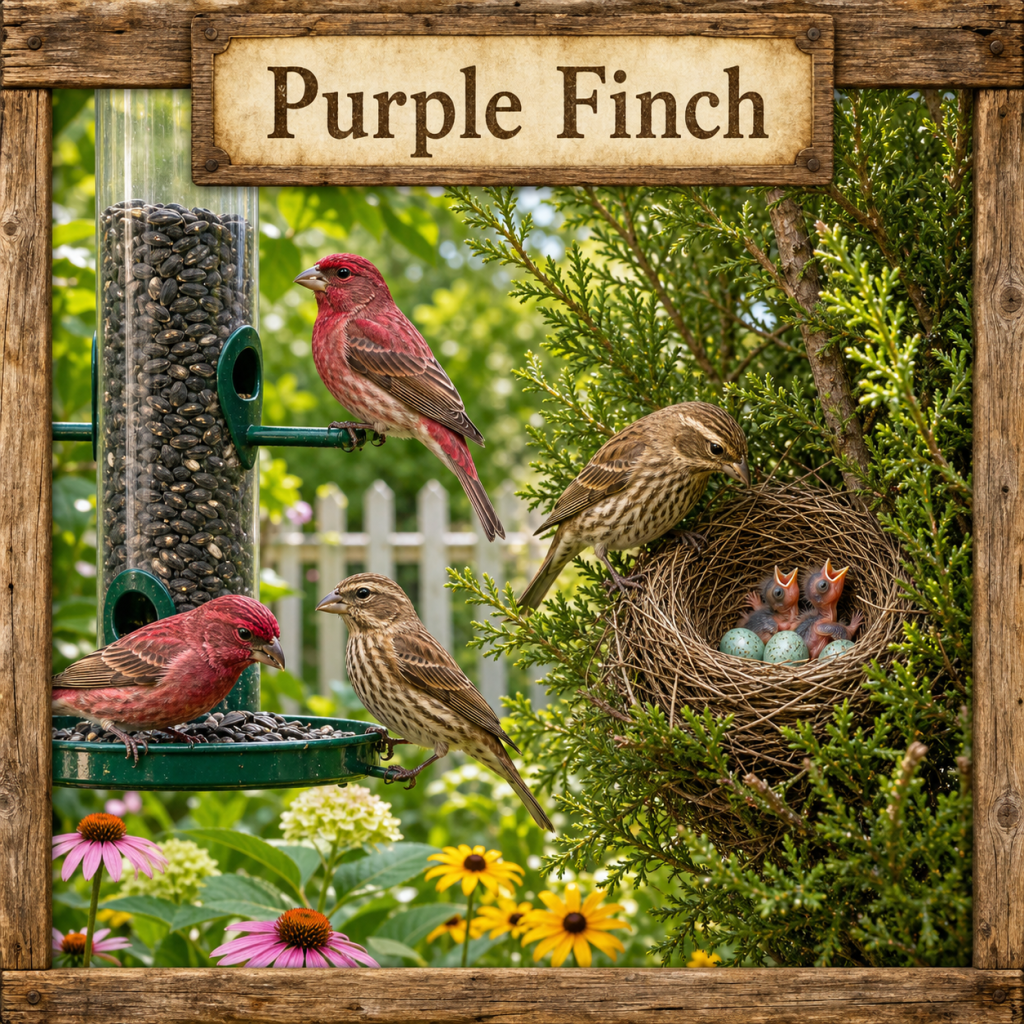
The purple finch is one of those birds that surprises people the first time they see it. It’s a medium-small songbird — about the size of a sparrow — but the male’s raspberry-red wash over the head, breast, and back makes it stand out immediately at the feeder. It’s not a neon red like a cardinal; it looks more like the bird was dipped in fruit punch, which is actually where the species gets its unusual name.
Purple finches can be excellent feeder visitors across a wide range of North America, though their visits often feel unpredictable if you don’t know their seasonal patterns. They move in loose flocks, especially in fall and winter, and when a group descends on a tube feeder, activity picks up fast. They’re not aggressive birds, but they’re confident — you’ll often see them nudging house sparrows or house finches aside to hold a perch.
Once purple finches find a dependable feeder, they may return to that yard during future flock movements. Setting up a reliable feeder station is the most consistent way to get regular visits. If you’re building your first station, How to Attract Backyard Birds is a good place to start.
Jump to What You Need
- Quick Facts
- How to Identify a Purple Finch
- Habitat & Range
- Best Feeders for Purple Finches
- Best Food
- Backyard Setup & Placement
- Seasonal Behavior
- Nesting
- Fun Facts
- Common Mistakes
- FAQ
Quick Facts
| Scientific Name | Haemorhous purpureus |
| Size | 4.7–6.3 inches long |
| Wingspan | 8.7–10.2 inches |
| Lifespan | Up to ~14 years |
| Feeder Friendliness | High |
| Range | Canada, northeastern U.S., Pacific Coast, and winter visitor across much of the central and southern U.S. |
| Best Feeder | Tube feeder |
| Best Food | Black oil sunflower seeds, safflower seeds, nyjer |
How to Identify a Purple Finch
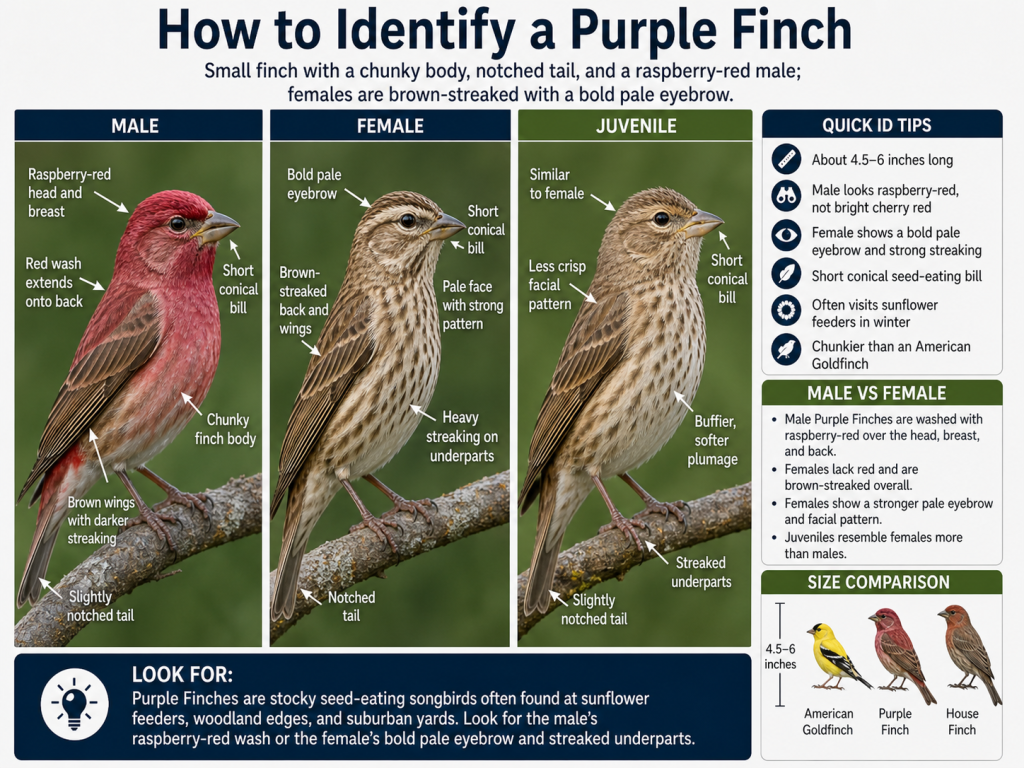
The male purple finch has a rich, raspberry-red coloring that covers the head, throat, breast, and upper back. The red fades into brown and white streaking on the belly and flanks. The overall impression is of a bird that’s been brushed with color rather than sharply marked. The female is quite different — brown and white with bold streaking and a strong white eyebrow stripe (supercilium) that gives her face a distinctive look.
Females and immature males are often mistaken for sparrows or house finches. The male purple finch is frequently confused with the male house finch, which is a very common ID challenge at feeders.
The single best ID trick: On the male, look at where the red color goes — a male house finch has red only on the head, throat, and rump, with a clearly streaked brown back. A male purple finch has red that bleeds into and over the back, giving a more uniformly rosy appearance. On females, the purple finch’s white eyebrow stripe is much bolder and more defined than the house finch’s subtler face pattern.
Calls and movement: The purple finch has a rich, warbling song — longer and more varied than the house finch’s song. Its call in flight is a sharp, dry “pit” note. At feeders, they tend to perch steadily and crack seeds with purpose rather than flitting around nervously. Watch for the notched tail in flight — slightly forked, which helps with ID.
Habitat & Range
Purple finches breed primarily across Canada and the northeastern United States, with a separate resident population along the Pacific Coast. In winter, they fan out across much of the eastern and central U.S., sometimes reaching the Gulf Coast states. Their winter distribution varies year to year — some winters bring large numbers south, others don’t.
In the backyard, purple finches are most reliably attracted in yards that border woodland or have mature trees nearby. They favor mixed forests, coniferous stands, and woodland edges. Suburban yards with mature plantings and some cover work well — an open lawn with no nearby trees is less likely to pull them in consistently.
Best Feeders for Purple Finch
The purple finch is one of the most feeder-friendly birds you can attract. If you’re comparing options across feeder types, Best Bird Feeders breaks down what works for different birds — but for a purple finch, the decision is usually straightforward.
Best Tube Feeder for Purple Finch ⭐
Tube feeders suit purple finches well because of how they feed. They’re comfortable clinging to a perch, cracking open shells, and holding a position without needing a wide ledge. A tube feeder with multiple ports gives a small flock room to feed at once without constant displacement.
Look for a tube feeder with metal ports around the seed holes — purple finches, like other finches, can enlarge plastic openings over time. A metal roof also helps keep seed dry, which matters because wet sunflower seed can clump and block ports.
One downside: tube feeders with small ports aren’t ideal if you’re also trying to attract larger birds like blue jays — but for a finch-focused setup, that’s rarely a problem.
👉 Tube Bird Feeders — Full Guide
Hopper Feeder — Good Secondary Option
Hopper feeders work well for purple finches and have the advantage of holding a larger seed volume — useful during winter when flocks move through and consumption spikes. Purple finches are comfortable feeding from hoppers, and the wider feeding surface accommodates more birds at once compared to a single tube.
The tradeoff is that hoppers attract a wider variety of birds, including house sparrows, which can be aggressive and crowd out finches. Positioning matters — keeping the hopper closer to cover helps finches feel secure.
👉 Hopper Bird Feeders — Full Guide
Platform Feeder — Useful in a Mixed Station
A low platform or tray feeder can supplement your setup, especially if you’re sprinkling millet or safflower for ground-level feeding. Purple finches don’t prefer the ground, but they’ll drop to a raised platform tray — especially in winter when seed is scattered by activity at the tube feeder above.
👉 Platform Bird Feeders — Full Guide
Best Food for Purple Finch
Getting the food right makes a bigger difference than most people expect. Choosing the right food can dramatically increase how often purple finches visit your yard — more so than any feeder upgrade. In the wild, purple finches eat seeds, berries, and tree buds — at feeders, they translate that preference directly into a strong response to a few specific seed types.
Black Oil Sunflower Seeds ⭐ Top Choice
Black oil sunflower seeds are the go-to for purple finches. The thin shells are easy for them to crack, the high fat content matches what they need during cold-weather visits, and nearly every feeder bird you want in your yard will eat them — making it the most practical single choice for a mixed station.
These work year-round but are especially effective from October through April when purple finches are most active at feeders in most of their winter range.
Safflower Seeds
Safflower is an excellent secondary option and has a practical bonus: many squirrels and house sparrows show less interest in it than sunflower. It won’t solve every crowding problem, but it can help shift the feeder mix in your favor — and if your tube feeder gets monopolized by sparrows, switching partly to safflower is worth trying.
Nyjer (Thistle)
Nyjer is more associated with American goldfinches, but purple finches will eat it — especially from a tube feeder with smaller nyjer ports. If you already have a nyjer feeder up for goldfinches, don’t be surprised when a purple finch joins in. It’s not their first choice, but it’s accepted.
What to Avoid
Milo, millet mixes, and generic “wild bird mix” blends are largely ignored by purple finches. These fillers are cheap but they attract birds that compete with finches for feeder space without drawing the finches themselves. Bread, crackers, and kitchen scraps are not appropriate for any feeder bird and can cause health problems over time.
Beginner shortcut: Start with a tube feeder and black oil sunflower seeds. That combination reliably attracts purple finches and creates the repeat visits that make backyard birding satisfying.
Backyard Setup & Placement
Place your tube feeder 5–10 feet from cover — a shrub, hedgerow, or low tree branch. Purple finches are alert birds and prefer to have a quick escape route nearby. Feeders sitting in the open middle of a yard tend to get fewer visits from finches, even when they’re stocked with the right seed.
Height matters less than proximity to cover, but hanging the feeder between 4 and 6 feet off the ground puts it in the zone where purple finches naturally move and feed. Avoid clustering multiple feeders too close together — 8–10 feet of spacing between stations keeps things calmer and reduces territorial squabbling.
A birdbath nearby adds real value, especially in winter when natural water sources are frozen. Purple finches drink regularly and are attracted to the sound of dripping or moving water. A heated birdbath or dripper attachment keeps activity going on cold days when feeder visits dip.
This setup works because purple finches are semi-woodland birds that feel safest when cover is close. Replicating the woodland edge — feeder near trees, water nearby, a clean sight line above — matches how they naturally move and forage, which is what keeps them coming back.
👉 How to Attract Backyard Birds 👉 Simple Backyard Bird Setup
Seasonal Behavior
Winter: This is when most backyard birders in the eastern and central U.S. will encounter purple finches. They move in loose flocks and can arrive suddenly in large numbers, then disappear for days. Feeder activity peaks when temperatures drop — keep seed well-stocked and consistent during cold snaps to capitalize on flock visits.
Spring: As winter ends, purple finches begin moving north toward breeding grounds. Feeder visits become less frequent by late March and April across most of the southern part of their winter range. This is a good time to hear their song — males sing frequently in late winter and early spring, making them easier to notice before they depart.
Summer: In their breeding range (Canada and northeastern U.S.), purple finches are present but less feeder-dependent in summer. They’re foraging on insects, berries, and tree seeds, and pairs are focused on nesting. Feeder visits may drop off entirely in many yards through June and July, even in areas where they breed.
Fall: Purple finches begin moving south in September and October. This is when they reappear at feeders across their winter range, often in small flocks. Fall is a good time to make sure your tube feeder is clean, well-stocked, and positioned correctly — early arrivals that find your yard are more likely to return throughout winter.
Nesting
Purple finches typically nest in coniferous or mixed forests, building cup-shaped nests of grasses, twigs, and moss in the outer branches of trees — usually 5–60 feet off the ground. They show a preference for spruce, fir, and pine trees and tend to nest away from developed areas, which means nesting activity in suburban backyards is uncommon even in their breeding range.
Unlike bluebirds or wrens, purple finches don’t readily use nest boxes. Planting or preserving native conifers near your yard is the most useful habitat support you can offer for nesting pairs. Dense shrubs can also serve as secondary cover for foraging birds during the breeding season.
Eggs per clutch: 4–5, sometimes 3–6
Broods per year: Usually 1; sometimes 2 in parts of the Pacific Coast range
Incubation: About 13 days
Nestling period: About 14 days before young leave the nest
Fun Facts
The name “purple finch” is famously misleading — the male’s color is far closer to raspberry-red or cranberry than purple. The name comes from the Latin purpureus, which historically described a range of deep red-pink tones, not the modern color we call purple.
Purple finches are nomadic in winter. Their movements are tied to food availability — specifically the seed crops of native trees and shrubs — which is why their feeder visits can seem random. A yard that gets a flock one week may see nothing for a month, then get hit again when the flock loops back.
The male takes about a year to develop full adult plumage. First-year males look much like females — streaky brown with just a hint of rosy wash — which leads to frequent misidentification at the feeder.
Purple finches have been declining in parts of their range since the 1960s, partly due to competition pressure from house sparrows and house finches — both of which have expanded their populations significantly. Feeder setups that reduce sparrow dominance (like safflower seed or cage feeders) may give purple finches better access.
Common Mistakes
Using the wrong seed. The most common error is stocking a generic mixed birdseed blend and wondering why finches don’t show up. Milo, millet, and filler seed mixes are largely ignored by purple finches. Black oil sunflower seeds are the reliable choice — they’re easy to crack, nutritious, and almost universally accepted by finches. If you’re not seeing results, check the seed before anything else.
Feeder placement that’s too exposed. A tube feeder hung in the center of an open yard looks like a logical choice — good visibility, easy to see the birds. But purple finches are cautious and prefer cover nearby. Feeders placed more than 15 feet from any shrub or tree cover get fewer finch visits. Moving the feeder closer to a hedge or fence line often makes a noticeable difference within a few days.
Assuming they’re gone for good when they disappear. Purple finches have nomadic winter habits. A flock that visits your yard heavily for a week can vanish completely for several weeks, then return. Many beginners assume they’ve done something wrong or that the birds are gone for the season. In most cases, the birds are simply following a larger flock circuit — keep the feeder stocked so your yard is ready if the flock loops back through.
Confusing them with house finches and giving up. The house finch is a year-round resident in most of the U.S. and is abundant at feeders. Purple finches are winter visitors in much of their range and are less common. If you’ve been watching what you thought were purple finches all year, they may be house finches — which is fine, but worth sorting out. Learning the ID distinction helps you notice when actual purple finches do show up.
Purple Finch FAQ
A tube feeder with metal-reinforced ports is the best choice for purple finches. They’re comfortable clinging to a perch and cracking seeds, and a tube feeder gives them a stable position without requiring a wide ledge. Fill it with black oil sunflower seeds and place it near some cover, and you’ll have the most reliable setup for attracting them. See the full Tube Bird Feeders — Full Guide for specifics on styles and placement.
Black oil sunflower seeds are consistently the top producer for purple finches. Safflower seeds are a strong second choice and may help discourage some squirrels and house sparrows, especially compared with sunflower seed. Nyjer will also be accepted, especially if you already have a nyjer feeder up for goldfinches. The Best Bird Seed guide covers the full breakdown of what works for which birds.
Look for the raspberry-red wash on the male’s head, breast, and back — it extends over the back in a way the house finch’s red coloring does not. Females are brown and white with heavy streaking and a bold white eyebrow stripe, which is more defined than on a female house finch. In flight, look for the notched tail. If you’re used to house finches, the male purple finch will look noticeably richer and more evenly red when seen side by side.
Yes, partially. Purple finches are migratory in much of their range. Breeding populations nest in Canada and the northeastern U.S. in summer, then spread south and east across the central and eastern U.S. for winter. A separate resident population lives along the Pacific Coast year-round. In much of the country, purple finches are winter-only visitors — typically arriving in October and departing by April.
The most likely explanation is that the flock has simply moved on — purple finches are nomadic in winter and follow food availability across a wide area. They’re not territorial about feeders the way cardinals or chickadees are. If your seed supply looks fine and the feeder is clean, just wait. Flocks often loop back to the same yards multiple times in a season. If visits stopped in March or April, they’ve likely departed for the breeding season.
Yes — purple finches are a great bird for beginning birders and feeder-watchers. They’re reliably attracted by common seed, easy to spot at the feeder, and their behavior (cracking seeds, short visits, occasional flock arrivals) is interesting to watch. The main learning curve is telling them apart from house finches, which is a useful ID skill that pays off across multiple species. Once you can reliably identify a purple finch, you’ll notice details on other streaky finches much more easily.
At a tube feeder in winter, you’ll commonly see American Goldfinch alongside purple finches — they overlap heavily in feeder preference and winter range. House finches are almost always present if you’re in their range and will compete for the same perches. Dark-eyed Juncos often appear at the same time of year and may feed below the feeder on dropped seed. Black-capped Chickadees and Downy Woodpeckers are common feeder companions across most of the purple finch’s winter range.
Related Pages
👉 Best Bird Feeders 👉 Tube Bird Feeders — Full Guide 👉 Best Bird Seed 👉 How to Attract Backyard Birds 👉 Backyard Birds by Species 👉 Finches — Species Guide 👉 American Goldfinch — Species Guide