

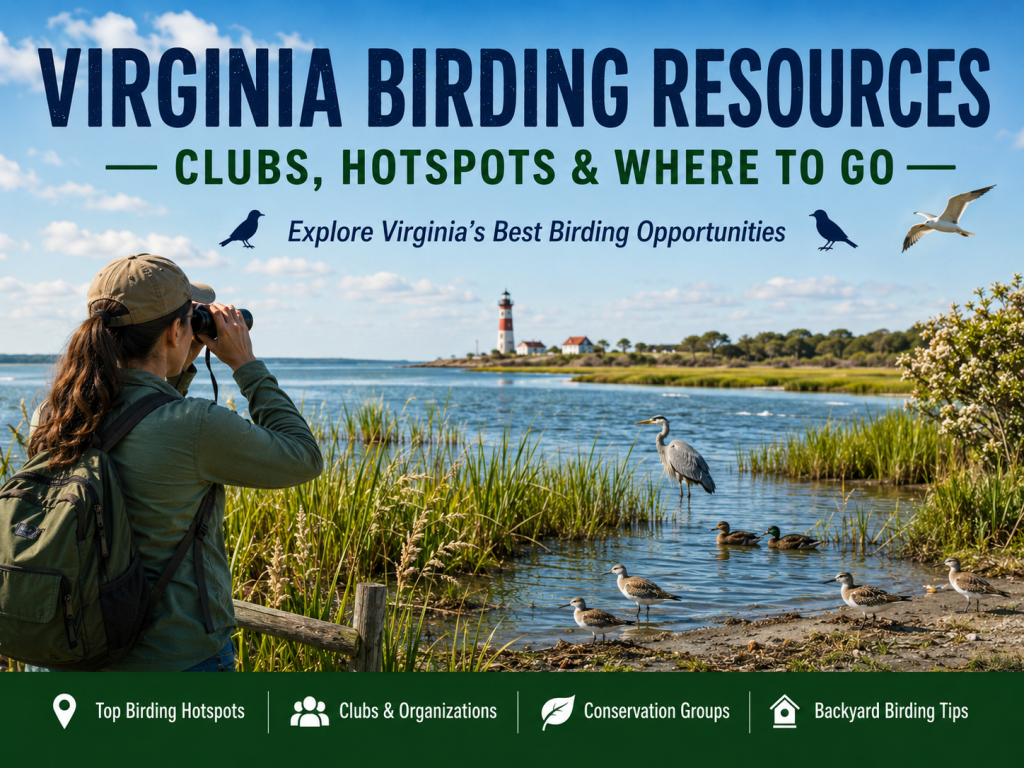
Virginia birding resources start with the state’s position at the crossroads of the Atlantic Flyway — where the Blue Ridge Mountains funnel migrating raptors south, the Chesapeake Bay holds enormous concentrations of wintering waterfowl, and the Eastern Shore acts as a geographic bottleneck that concentrates large numbers of songbirds, hawks, and shorebirds every fall. The result is a state where something significant is always happening for birders, from January waterfowl counts on the Bay to fall migration along the Delmarva Peninsula. More than 490 bird species have been recorded in Virginia.
These Virginia birding resources will help you find the state’s best regions, hotspots, organizations, and beginner-friendly tools — organized from the mountains west to the coast.
If your interest is specifically in backyard birding, the Virginia Backyard Birds guide covers feeder setup, common species, and what to expect by season. For the Northern Cardinal — Virginia’s official state bird — see the Virginia State Bird guide.
Who This Guide Is For
This guide is for backyard birders who are ready to explore beyond the feeder, beginners looking for easy places to see more birds, and experienced birders who want quick access to trusted Virginia birding resources — from local hotspots to organizations that host field trips, maintain checklists, or protect habitat.
If you’re just starting out, Virginia is forgiving. The state has exceptional beginner-friendly sites — Chincoteague National Wildlife Refuge, Occoquan Bay National Wildlife Refuge, and Kiptopeke State Park are all easy to navigate, well-documented on eBird, and reliably productive across multiple seasons. If you already know the basics, the hotspot and organization sections below will help you find better locations, seasonal peaks, and the local experts who know this state best.
Jump to Birding Resources
- Top Birding Regions
- Best Birding Hotspots
- Virginia Birding Organizations
- Local Audubon Chapters & Regional Birding Groups
- Local Birding Clubs
- Wildlife & Conservation Groups
- eBird & Birding Apps
- Best Times to Go Birding in Virginia
- Tips for Birding Virginia
- Start in Your Own Backyard
- FAQ
- Related Resources
Top Birding Regions in Virginia
The Eastern Shore
Virginia’s Eastern Shore — the narrow Delmarva Peninsula separating the Chesapeake Bay from the Atlantic — is the state’s most important region for fall migration. Songbirds, raptors, and shorebirds funnel down the peninsula before the open-water crossing south, creating concentrated fallouts that rival anything on the East Coast. Kiptopeke State Park at the peninsula’s southern tip is the most famous site, with a hawk watch platform and banding station operating every fall. Chincoteague National Wildlife Refuge, further north on Assateague Island, adds shorebird and waterfowl habitat that produces good birds year-round.
Key species: American Oystercatcher, Red Knot, Peregrine Falcon, Merlin, Sharp-shinned Hawk, Nelson’s Sparrow, Black Scoter, Yellow-rumped Warbler
The Chesapeake Bay & Tidal Rivers
The Bay and its tidal rivers define birding across central and lower Virginia from late fall through early spring. Tundra Swans arrive by the tens of thousands from November onward, and diving duck diversity — scaup, canvasback, bufflehead, ruddy duck — makes the Bay one of the most productive waterfowl destinations in the eastern United States. The James, York, and Rappahannock rivers all hold concentrations of wintering waterfowl accessible from multiple boat ramps and shoreline pullouts.
Key species: Tundra Swan, Canvasback, Greater and Lesser Scaup, Long-tailed Duck, Common Goldeneye, Bald Eagle, Brown Pelican, Forster’s Tern
Northern Virginia & the Piedmont
The DC suburbs and the rolling Piedmont between the Blue Ridge and the fall line produce a strong mix of year-round residents alongside migrants moving through the Potomac and Rappahannock corridors. Mason Neck State Park and the Occoquan Bay National Wildlife Refuge sit within an hour of most of the Northern Virginia population and provide marshes, open water, and forest edge that hold an impressive variety of species. The Piedmont’s farm ponds, hedgerows, and second-growth woodlands are productive for sparrows and raptors in winter.
Key species: Bald Eagle, Osprey, Great Blue Heron, Pileated Woodpecker, American Bittern, Winter Wren, Eastern Towhee, Red-shouldered Hawk
The Blue Ridge & Shenandoah Valley
The mountains and the broad agricultural valley between them offer a different suite of species than the rest of the state. Shenandoah National Park’s Skyline Drive is among the most reliable locations in Virginia for fall hawk watching outside the Eastern Shore, with Rockfish Gap at the south end producing excellent numbers of Broad-winged and Sharp-shinned Hawks in September. The Valley’s open farmland supports large flocks of American Pipits, Horned Larks, and occasionally Short-eared Owls in winter, while the ridges hold nesting Cerulean Warblers, Black-throated Blue Warblers, and Veeries through summer.
Key species: Broad-winged Hawk, Cerulean Warbler, Black-throated Blue Warbler, Veery, Ruffed Grouse, American Pipit, Short-eared Owl, Horned Lark
Southwest Virginia & the Highlands
The southwestern corner of Virginia — Highland County, Grayson Highlands, and the New River Valley — is geographically and ecologically distinct from the rest of the state. Spruce-fir forests at elevation hold breeding species rarely found elsewhere in Virginia, including Red Crossbill, Golden-crowned Kinglet, and Hermit Thrush. Grayson Highlands State Park and Mount Rogers National Recreation Area are the primary destinations in this region, with habitat that more closely resembles New England than the Mid-Atlantic.
Key species: Red Crossbill, Dark-eyed Junco, Hermit Thrush, Golden-crowned Kinglet, Common Raven, Purple Finch, Blue-headed Vireo, Least Flycatcher
Best Birding Hotspots in Virginia
The following are among Virginia’s most productive and accessible birding sites. Most are well documented on eBird with species lists, recent sightings, and seasonal activity patterns.
Chincoteague National Wildlife Refuge (Accomack County, Eastern Shore) One of the most visited birding destinations on the mid-Atlantic coast, Chincoteague protects barrier island habitat on Assateague Island that supports shorebirds, wading birds, waterfowl, and a wide variety of migrants. The Wildlife Loop road — open to foot and bike traffic in the morning before vehicles are allowed — gives close access to impoundments where shorebird and waterfowl diversity peaks in late summer and fall. The refuge is productive year-round, but late July through October is the prime window. 👉 Chincoteague NWR — US Fish & Wildlife Service
Kiptopeke State Park (Northampton County, Eastern Shore) The hawk watch platform at Kiptopeke is the signature fall birding event on the Eastern Shore. From mid-September through late October, thousands of Broad-winged, Sharp-shinned, and Cooper’s Hawks move through daily alongside Peregrine Falcons, Merlins, and American Kestrels. The park’s banding station — one of the busiest on the East Coast — processes thousands of songbirds each fall, and eBird hotspot data here is exceptionally detailed. 👉 Kiptopeke State Park — Virginia State Parks
Mason Neck State Park (Fairfax County) Mason Neck is a peninsula on the Potomac River in Northern Virginia known for one of the largest Bald Eagle concentrations accessible to the DC metro area. The state park and adjacent national wildlife refuge share trails through mature forest, freshwater marsh, and Potomac shoreline. Great Blue Heron nesting colony, wintering waterfowl on Belmont Bay, and breeding forest species make this site productive in any season. 👉 Mason Neck State Park
Occoquan Bay National Wildlife Refuge (Prince William County) One of Northern Virginia’s most underrated sites, Occoquan Bay NWR sits at the confluence of the Occoquan River and the Potomac and holds surprising variety given its suburban surroundings. Marsh, grassland, and forest edge come together in a compact area that produces sparrows, raptors, waterfowl, and shorebirds across seasons. The grassland section is one of the best places in Northern Virginia to find American Kestrel and Eastern Meadowlark in winter. 👉 Occoquan Bay NWR — US Fish & Wildlife Service
Rockfish Gap (Augusta/Nelson County line) The gap where the Blue Ridge Parkway and Skyline Drive connect is Virginia’s most consistent mountain hawk watch location in fall. Broad-winged Hawk numbers peak here in mid-September, and the site also produces good counts of Osprey, American Kestrel, and Cooper’s Hawk through October. The surrounding forest along the drive holds breeding warblers and vireos in spring and summer. 👉 Rockfish Gap eBird Hotspot
Shenandoah National Park — Skyline Drive (Warren to Rockingham County) The 105-mile Skyline Drive runs the length of Shenandoah’s ridge, with overlooks and trailheads providing access to excellent mountain birding. Spring migration through the hardwood forest brings waves of warblers and vireos; summer breeding species include Cerulean Warbler, Worm-eating Warbler, and Black-throated Green Warbler. Big Meadows, at the park’s midpoint, is particularly productive for open-country species that don’t otherwise appear in the surrounding forest. 👉 Shenandoah National Park
Stumpy Lake Natural Area (Virginia Beach) A city-owned natural area in Virginia Beach that consistently produces marsh and wetland species rarely found this close to an urban core. King Rail, Least Bittern, and Common Gallinule breed here in summer, and the impoundment holds migrating shorebirds and waterfowl in season. Stumpy Lake is one of the most reliable sites in coastal Virginia for secretive marsh birds. 👉 Stumpy Lake eBird Hotspot
Grayson Highlands State Park (Grayson County, Southwest Virginia) At nearly 5,000 feet elevation, Grayson Highlands supports spruce-fir forest and open highland meadows that are ecologically unlike anything else in Virginia. The park produces breeding Dark-eyed Juncos, Common Ravens, and Red Crossbills alongside Golden-crowned Kinglets and Hermit Thrushes. The open balds also attract raptor migration in fall. This is a destination site for birders specifically seeking Virginia’s highland specialties. 👉 Grayson Highlands State Park
Virginia Birding Organizations
Virginia has a well-established network of birding and conservation organizations supporting bird watching, education, and habitat protection across the state. Connecting with these groups gives you access to rare bird alerts, organized field trips, and local expertise that’s hard to replicate on your own.
Statewide
Virginia Society of Ornithology The VSO is the primary statewide birding organization and the first stop for any serious Virginia birder. They publish the Virginia journal The Raven, maintain the state checklist, coordinate the Virginia Breeding Bird Atlas, and host an annual meeting that draws birders from across the state. Their rare bird alert and resources page are particularly useful for tracking current sightings statewide.
Virginia Department of Wildlife Resources The state agency that manages Virginia’s wildlife areas, boat launches, and public lands — many of which are excellent for birding. Their website includes property maps and access information for Wildlife Management Areas, some of which (Mockhorn Island, Ragged Island, Amelia WMA) are among Virginia’s least-visited but most productive birding sites.
Virginia Working Landscapes — Smithsonian Conservation Biology Institute A program focused on birds in Virginia’s agricultural landscapes — farmland, grasslands, and hedgerows. Useful for understanding which species depend on working lands and how citizen science data shapes conservation outcomes in those habitats.
Local Audubon Chapters & Regional Birding Groups
Virginia has a strong network of active regional Audubon chapters, bird clubs, and conservation groups that host field trips, educational programs, and community walks throughout the year. These are among the best ways to connect with experienced local birders and find out where birds are actually showing up right now.
- Audubon Society of Northern Virginia — Serves the DC metro area and Northern Virginia; one of the most active chapters in the state with a strong field trip program and a beginner-friendly approach across Fairfax, Arlington, and surrounding counties.
- Loudoun Wildlife Conservancy — Loudoun County-focused with an active birding and nature monitoring program; particularly strong on breeding bird surveys and citizen science in the Northern Virginia Piedmont.
Note: Some chapters have rebranded or reorganized in recent years. If a link is outdated, search the organization name directly or check the full National Audubon chapter directory at audubon.org/chapters.
Most chapters welcome beginners and don’t require any prior experience.
Local Birding Clubs
Independent birding clubs give you a smaller, community-focused alternative to larger organizations — regular outings, informal identification help, and a pace that works well for newer birders just getting started.
- Roanoke Valley Bird Club — Covers the Roanoke Valley and surrounding Blue Ridge foothills; hosts monthly meetings, field trips, and Christmas Bird Counts for western Virginia.
- Williamsburg Bird Club — Serves Williamsburg, Hampton Roads, and the Colonial National Historical Park area; regular field trips with strong coverage of coastal and tidal sites.
- Rockbridge Area Bird Club — Covers the Lexington and Rockbridge County area in the Shenandoah Valley; informal outings and local bird reports for the central valley region.
- Lynchburg Bird Club — Active club serving the greater Lynchburg area in the Piedmont; regular field trips across central Virginia and the Blue Ridge foothills.
Wildlife & Conservation Groups
These organizations focus on habitat protection and wildlife rehabilitation in Virginia — both of which directly affect the bird populations birders depend on.
- The Nature Conservancy — Virginia — Manages significant conservation lands across Virginia including properties on the Eastern Shore and in the mountains; their work directly protects habitat for migrating shorebirds, breeding warblers, and wintering waterfowl.
- Center for Conservation Biology — William & Mary — Research center focused on eagle, colonial waterbird, and shorebird conservation in Virginia and the Chesapeake Bay region; their long-term monitoring data on Bald Eagles, Ospreys, and colonial nesting species is some of the most detailed available for the mid-Atlantic.
- Wildlife Center of Virginia — Waynesboro-based wildlife hospital that rehabilitates native birds across the state; the organization to contact if you find an injured bird in Virginia.
eBird & Birding Apps for Virginia
eBird (Cornell Lab of Ornithology) The essential tool for Virginia birding. Search any location to see recent sightings, explore hotspot species lists, and contribute your own observations. Virginia’s eBird dataset is one of the most robust in the mid-Atlantic — sites like Kiptopeke, Chincoteague, and Mason Neck have thousands of documented checklists that give you a detailed picture of what’s present in any given week of the year. Use the eBird hotspot map before visiting any new site to see what’s been reported in the last 30 days.
Merlin Bird ID (Cornell Lab) Download the Virginia bird pack before heading out so Merlin can help with the species you’re most likely to encounter. The Sound ID feature is particularly useful — hold the phone up in a new habitat and it will list what it hears in real time.
iNaturalist Broader than birds but useful for documenting rare sightings and connecting with local naturalists across Virginia. The Virginia iNaturalist community is notably active, particularly in the Northern Virginia and Hampton Roads areas, making it a useful supplement to eBird for cross-referencing observations at unfamiliar sites.
Virginia Avian Records Committee (VARCOM) The official body that reviews and maintains Virginia’s accepted state bird records, run by the Virginia Society of Ornithology. The VARCOM checklist is the authoritative list of species recorded in the state, and their review criteria and records archive are useful for birders tracking state lists or reporting potential rarities.
Best Times to Go Birding in Virginia
Virginia birding is productive year-round — but timing shapes what you’ll find dramatically.
Spring Migration (April – May) Spring migration peaks in late April and early May, when waves of warblers, vireos, tanagers, and thrushes move through Virginia’s woodlands on their way north. The Blue Ridge forests and Shenandoah Valley are particularly good during this period, with Cerulean and Blackburnian Warblers singing from ridgeline oaks. The Chesapeake coast and Eastern Shore see good shorebird movement through May as sandpipers and plovers push toward Arctic breeding grounds.
Summer (June – August) Summer slows migration but rewards mountain birders. The forests of Shenandoah National Park and Grayson Highlands are at their most active in June, with singing warblers, vireos, and forest thrushes easy to locate by ear. Shorebird southbound migration quietly restarts in late July at Chincoteague and other coastal impoundments, making late summer a good time to return to the coast.
Fall Migration (September – November) Fall is Virginia’s peak birding season. The Eastern Shore hawk watch runs through October with some of the best raptor counts on the East Coast, while songbird migration creates fallout conditions at coastal thickets and wooded ridges throughout September. Waterfowl begin arriving on the Bay in October, and by November the Chesapeake holds major concentrations of Tundra Swans and diving ducks.
Winter (December – February) The Chesapeake Bay holds peak waterfowl diversity through January, with Common Loon, Horned Grebe, and multiple scoter species mixing with ducks and swans on the open water. Open farmland in the Shenandoah Valley and Piedmont produces Short-eared Owls, American Pipits, and large sparrow flocks in good winters. Feeder activity is strong across the state, with Dark-eyed Juncos, White-throated Sparrows, and occasional Pine Siskins or Purple Finches in irruption years.
Tips for Birding Virginia
For Eastern Shore migration (September–October): Plan your visit around wind direction. Northwest winds following a cold front push migrating songbirds and raptors down the peninsula and concentrate them at Kiptopeke and in Eastern Shore thickets. A morning after a front, with clear skies and northwest winds, is when fallout conditions happen. Arrive early — hawk watching and banding at Kiptopeke begins at first light.
For Chesapeake Bay waterfowl (November–February): Several Virginia Department of Wildlife Resources boat ramps on the James, York, and Rappahannock rivers provide shore-based access to coves where diving ducks concentrate. On very cold days when the Bay partially freezes, birds push into tidal rivers and become far more accessible from land.
For mountain birding in Shenandoah: The Skyline Drive at elevation runs 10–15 degrees cooler than the Valley below, and weather can change quickly. Early morning is essential — bird activity along the drive drops sharply after 9 or 10am in summer. The Big Meadows and Lewis Mountain area reliably produces the best warbler diversity in the park.
For Southwest Virginia’s highland specialties: Grayson Highlands and the Mount Rogers high country are best visited from May through early July for breeding species, and late September through October for fall migrants crossing the open balds. Allow more driving time than the mileage suggests, and check road conditions if visiting in winter or early spring.
General: Check eBird before any Virginia birding trip. The recent sightings data — particularly at named hotspots — will show you exactly what’s been seen in the last 30 days at any location. It’s the single most useful pre-trip planning tool available.
Start in Your Own Backyard
Not every birding experience requires a trip. For many Virginia residents, the backyard — or a balcony, a patio, or a neighborhood park — is the first and most reliable place to build bird identification skills.
Virginia’s suburban and rural areas support a strong mix of year-round feeder birds. Northern Cardinals, Carolina Chickadees, Carolina Wrens, Downy Woodpeckers, and White-breasted Nuthatches are present at feeders across most of the state in every month of the year. Come winter, Dark-eyed Juncos and White-throated Sparrows join the mix in numbers, and in irruption years Pine Siskins and Purple Finches can appear unexpectedly at feeders that normally see only House Finches.
Virginia’s mild climate and varied habitats mean backyard birding is genuinely interesting across all four seasons — spring migration brings warblers and orioles through treetops overhead, summer brings Ruby-throated Hummingbirds to native plantings, and fall sends Fox Sparrows and Hermit Thrushes through shrubby borders before winter closes in. Learning your regular feeder birds first makes field birding much easier — you start recognizing size, movement, beak shape, calls, and seasonal patterns before you ever visit a hotspot.
👉 Virginia Backyard Birds 👉 How to Attract Backyard Birds 👉 Simple Backyard Bird Setup 👉 Best Bird Feeders 👉 Best Bird Seed
Frequently Asked Questions
Kiptopeke State Park and Chincoteague National Wildlife Refuge are Virginia’s most celebrated birding destinations — Kiptopeke for its fall hawk watch and songbird banding, Chincoteague for year-round shorebird and waterfowl variety. For birders in Northern Virginia, Mason Neck State Park and Occoquan Bay National Wildlife Refuge offer comparable diversity much closer to the DC suburbs. The right choice depends on the season and what you’re after: raptors and warblers in fall push you toward the Eastern Shore; waterfowl in winter points to the Chesapeake and its tidal rivers.
Yes — the Audubon Society of Northern Virginia, the Williamsburg Bird Club, and the Roanoke Valley Bird Club all run beginner-friendly field trips and welcome new participants without any prior experience. Most outings move at a relaxed pace with experienced birders happy to help with identification. Checking each chapter’s event calendar is the easiest way to find a walk near you.
The official state bird of Virginia is the Northern Cardinal. It is one of the most recognizable birds at Virginia feeders year-round — the male’s brilliant red plumage makes it unmistakable even for beginning birders, and the female’s warm brown tones with red-washed wings are equally distinctive up close. For identification tips, habitat details, and the history behind the designation, see the Virginia State Bird guide.
Virginia supports more than 490 recorded species across habitats ranging from Atlantic barrier islands to Appalachian spruce-fir forest. Year-round residents include Northern Cardinal, Carolina Wren, Pileated Woodpecker, Bald Eagle, and Great Blue Heron. Spring and fall bring massive waves of warblers, shorebirds, and raptors through the state’s flyway corridors. Winter fills the Chesapeake Bay with Tundra Swans, Canvasbacks, and scaup in numbers that rival any waterfowl destination in the East. 👉 Virginia Backyard Birds
Fall — specifically September through November — offers the greatest overall variety and spectacle, with the Eastern Shore hawk watch, coastal songbird migration, and early arriving waterfowl all happening simultaneously. Spring (late April–May) is the runner-up, particularly for breeding warblers along the Blue Ridge. Winter is underrated for Chesapeake waterfowl and open-country species in the Valley. Virginia is genuinely productive in all four seasons.
Start at your feeder. Virginia’s Northern Cardinals, Carolina Chickadees, and Carolina Wrens are year-round constants that teach you to read size, shape, behavior, and movement before you ever go to the field. Once those feel familiar, Occoquan Bay National Wildlife Refuge or Mason Neck State Park are excellent first field sites for Northern Virginia residents — easy trails, strong eBird coverage, and multiple habitat types in a compact area. Take Merlin with you and use Sound ID. 👉 Simple Backyard Bird Setup
Use eBird before you go and Merlin when you’re in the field. Before any Virginia birding trip, pull up the eBird hotspot page for your destination and check what’s been seen in the last 30 days — it will tell you whether shorebirds are still present at Chincoteague or whether the hawks are moving at Kiptopeke. In the field, Merlin’s Sound ID feature handles Virginia’s dense summer woodland chorus better than trying to sort warblers by ear from scratch.
Virginia is one of the better mid-Atlantic states for fall hawk watching. Kiptopeke State Park on the Eastern Shore is the flagship site, with thousands of Sharp-shinned Hawks, Cooper’s Hawks, and Peregrine Falcons counted each fall alongside Merlins and American Kestrels. Rockfish Gap at the southern end of Skyline Drive is the best ridge-based hawk watch in the state, particularly for Broad-winged Hawks in mid-September. Both sites are active from mid-September through early November, with the peak window typically falling in the last two weeks of September.
Related Resources
👉 Virginia Backyard Birds 👉 Virginia State Bird — Northern Cardinal 👉 Birding Resources by State 👉 Backyard Birds by State 👉 All 50 U.S. State Birds 👉 How to Attract Backyard Birds 👉 Simple Backyard Bird Setup 👉 Best Bird Feeders 👉 Best Bird Seed